Ikalto
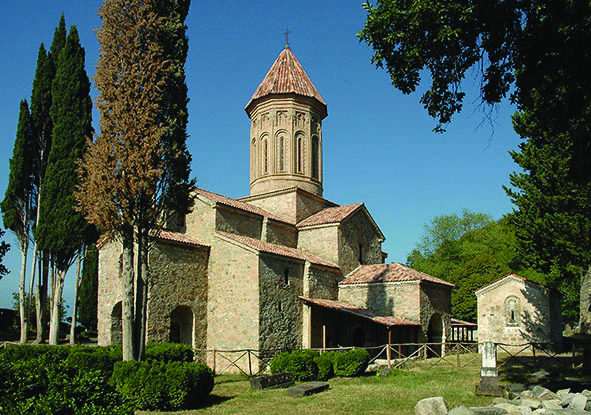
Ikalto is a Georgian architectural monument and monastic complex situated approximately 1 kilometer south of the village of Ikalto. The site preserves the churches of the Transfiguration, the Trinity, and All Saints, alongside the academy building, a refectory, a wine cellar (marani), the remnants of six additional churches, and several other structural ruins.
The monastery was founded in the second half of the 6th century by one of the Thirteen Assyrian Fathers, Saint Zenon Ikaltoeli [Zenon of Ikalto]. During the Middle Ages, following the establishment of the academy here by Arsen Ikaltoeli [Arsen of Ikalto] (11th–12th centuries), the significance of the monastery went beyond the borders of Kakheti, transforming it into a major cultural and educational center for the whole Georgia.
The primary structure among the monastic churches is the Church of the Transfiguration (known as the Gvtaeba [Deity]). It was presumably constructed in the 9th century on the site of an earlier church where the monastery's founder, Saint Zenon, was buried. In the 19th century, the ruined parts of the building's walls were restored, a new high-rimmed dome was installed; the church was plastered and whitewashed both internally and externally.
Architecturally, the church belongs to the inscribed-cross (cross in square) typological classification. It features three entrances located to the south, west, and north, with all three doorways cut into the center of their respective cross-arms. A defining architectural characteristic of the church is its dome, which is supported by four pillars. These sub-domical piers are cross-shaped in plan.
The Trinity Church stands approximately 10 to 12 meters east of the Church of the Transfiguration. It was originally a domed structure, but following its destruction, it was rebuilt in the 19th century and modified into a hall church design. Within the floor of the porch, directly preceding the entrance to the church, lies a rectangular shaft leading down to a crypt beneath the temple. The crypt itself was unaffected by the reconstruction and has been preserved unaltered.
The All Saints Church, a hall church dating to the 11th–12th centuries, stands south of the Gvtaeba church. South of the monastery's main temple lies the academy building, constructed using cobblestones.
The Church of Saint Nino is located 30 meters west of the main complex and was previously completely buried under soil. In 2012, the interior of the church and portions of its exterior walls were excavated and cleared. It is an apsidal hall church constructed with irregular courses of broken stone. Its sole entrance (of which only a small portion of the jambs survives) is located on the northern side.
Literature: პ. ზაქარაია საქართველოს ძველი ციხესიმაგრეები, თბ., 1988; საქართველოს ისტორიისა და კულტურის ძეგლთა აღწერილობა, ტ. 1–II, თბ., 2015; Чубинашвили Г. Н., Aрхитектура Kахетии, Тб., 1959.
T. Dvali