Tbilisi First Gymnasium
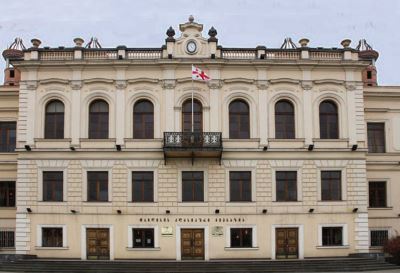
Tbilisi First Gymnasium, the Tbilisi First Classical Gymnasium, or the First Classical Gymnasium for Boys was established in 1830 on the foundation of the previously existing School for the Nobility (active since 1802). For two decades, this gymnasium was the sole secular educational institution in Georgia, and for several decades, it remained the only European-style secular educational establishment in Southern Caucasus.
The gymnasium consisted of seven grades. The core curriculum included: Religious Studies, Georgian, "Tatar" (Azerbaijani), German, and French languages, mathematics, physics, history, Russian philology and logic, geography and statistics, calligraphy, drawing, and Russian jurisprudence. The study of the Georgian language was mandatory for all students without exception. By 1831, the student body included N. Baratashvili, K. Mamatsashvili, D. Machabeli, and others. From 1835, students produced a Russian-language manuscript journal titled The Flower of the Tbilisi Gymnasium. B y 1847, the number of students had increased to 467, including I. Kereselidze, I. Chavchavadze, B. Ghoghoberidze, and others.
On January 2 (14), 1850, G. Eristavi’s play The Separation (Gagra) was first performed within the gymnasium building; this date is commemorated annually on January 14 as Georgian Theater Day. Following the reforms of the 1860s, the institution was designated a “Classical Gymnasium,” aligning it with analogous institutions of the Russian Empire, with the distinction that only Latin was taught (excluding Greek). Gradually, the Georgian language was entirely purged from the curriculum. In 1900, the gymnasium enrolled 824 students. Notable faculty members at various times included: S. Dodashvili, G. Gekhtman, E. Takaishvili, D. Dondua, V. Abdushelishvili, D. Kipiani, B. Ghoghoberidze, I. Kereselidze, A. Purtseladze, and P. Umikashvili.
Following the establishment of Soviet rule in Georgia, the gymnasium was transformed into a “Labor School,” and from 1923, it became the “First Experimental-Demonstrative School.” Traditionally, the school retained the title of the capital’s “First School.” Between 1997 and 2005, it functioned as the Tbilisi First Classical Gymnasium, with a curriculum emphasizing Latin, Russian, English, German, and Persian languages, as well as the history and literature of antiquity. From 2005 to 2011, it was named the Tbilisi 1st Public School. In 2012, it regained the title of Gymnasium, and the teaching of traditional subjects was restored.
Among the graduates of Tbilisi First Gymnasium were famous poets and public figures, such as: N. Baratashvili, I. Chavchavadze, S. Dodashvili, E Takaishvili, D. Kipiani, etc.
L. Shetsiruli