Tbilisi Fortress (Narikala)
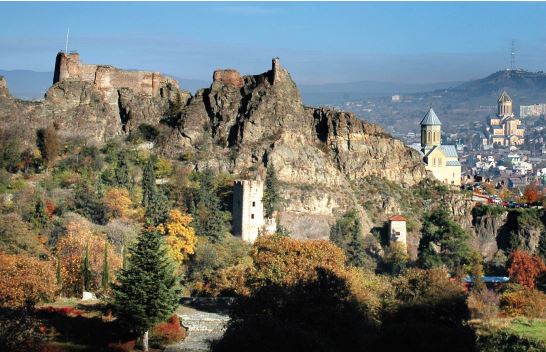
Tbilisi Fortress, a medieval fortification located in the southeastern part of Tbilisi, on the left bank of the river Tsavkisistskali. Between the 4th–18th centuries, it appears in Georgian and foreign historical sources under the names Kala, Shuristsikhe, the Citadel of Tbilisi, Tsikhe, Maghlatsikhe, and Narikala. It is supposed that the site was inhabited since antiquity (a bronze dagger dating to the 13th–12th centuries BCE has been discovered there).
Leontius Mroveli attributes the founding of the fortress to Khram Khuar Borzard, a pytiaxes (pitiakhshi) of the Persian King who arrived in Kartli in 368 CE. The term "Narikala" first appears in 17th-century records. It is noteworthy that in the 17th–18th centuries, every significant fortress (including Dmanisi, Gori, Sighnaghi, etc.) possessed its own narikala (inner citadel), though the name eventually survived only in reference to the Tbilisi Fortress.
In the second half of the 6th century, the strategic importance of the fortress increased, serving as the dominant defensive structure of the feudal city. In 627 CE, it was besieged by the joint forces of the Byzantine Emperor Heraclius and the Khazar Khagan Jibghu. The defenders, reinforced by a Persian detachment, repelled the enemy. In 628, the allies attacked Kala again, successfully capturing and destroying it.
In the 11th century, Bagrat IV made several attempts to liberate Tbilisi. In 1045, invited by the city's elders, Bagrat first seized the main citadel. In 1122, David the Builder secured the Tbilisi Fortress along with the city. In 1226, Jalal ad-Din launched a massive assault and, with the assistance of the city's Muslim population, managed to capture it. The subsequent invasion is linked to Tamerlane's (Temur Lengi) first campaign; in November 1386, he besieged Tbilisi, capturing the city and its fortress on November 21.
In 1541, Shah Tahmasp I campaigned against Tbilisi. In 1578, Mustafa Lala Pasha seized the fortress, and an Ottoman garrison remained there until 1606, after which it was held by the Qizilbash for over a century. During the reign of King Rostom (1632–58), a wall was constructed from Khidisquri to the Kala fortress, dividing the city and the citadel. This led to the micro-toponym "Dabla Tsikhe" (Lower Fortress) in contrast to "Maghla Tsikhe" (Upper Fortress). The Turkish traveller Evliya Çelebi who visited the site during this period provided its description.
In 1747–48, the fortresses of Tabori, Metekhi, and Narikala were held by Qizilbash supporters of Abdullah Beg. Erekle II first took Tabori and Metekhi, then the Lower Fortress, and finally Narikala, permanently ending the Qizilbash presence. The final devastating invasion occurred in 1795 during Agha Mohammad Khan’s campaign and the Battle of Krtsanisi.
Following the annexation of the Kingdom of Kartl-Kakheti by the Russian Empire (1801), the fortress lost its prior significance. In the first half of the 19th century, an explosion of a gunpowder in one of the buildings destroyed almost all structures, including the Church of St. Nicholas. Only some of the 12th–13th and 17th centuries structures survived to this day.
The fortress was largely inaccessible. Water was supplied via a specialized system of channels and aqueducts (depicted in Tournefort’s 1701 drawing). The fortress church appears on Vakhushti Bagrationi’s 1735 plan and later Chuiko’s 1800 plan. Archaeological excavations in the 1960s–80s revealed medieval ruins, ceramics, glass, and coins. Restoration took place in the 1970s–80s, and in the 1990s, a new church was built upon the 12th–13th century foundations of St. Nicholas.
Sources: მოქცევაჲ ქართლისაჲ. შატბერდის კრებული, გამოსაცემად მოამზადეს ბ. გიგინეიშვილმა და ელ. გიუნაშვილმა, თბ., 1979; ქართლის ცხოვრება, ს. ყაუხჩიშვილის გამოც., ტ. 1, 4, თბ., 1955–73; ქართლის ცხოვრება, რედ. რ. მეტრეველი, თბ., 2008.
Literature: კვირკველია თ., ძველთბილისური დასახლებანი, თბ., 1985; მესხია შ., გვრიტიშვილი დ., დუმბაძე მ., სურგულაძე ა., თბილისის ისტორია, თბ., 1958; ჯანაშია ს., თბილისის ისტორია, შრომები, [ტ.] 1, თბ., 1949.
T. Beridze