Tbilisi State Academy of Arts
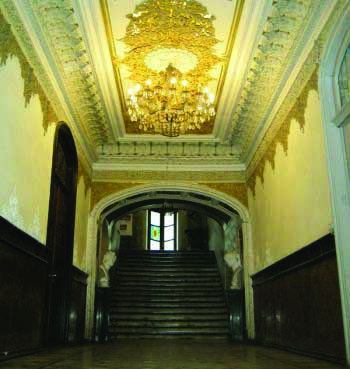
Tbilisi State Academy of Arts named after A. Kutateladze (until 1933 – the Georgian Academy of Arts), the first national higher art institution, was founded in 1922. The ground for the foundation of the Academy was prepared by the art schools existing in Tbilisi since the 1870s and the artists who studied in the art schools and studios of European countries. The Society of Georgian Artists, established in 1916, was the initiator of the Academy’s establishment. At the time of its foundation, the Academy included such renowned artists as G. Chubinashvili (first rector), G. Gabashvili, I. Nikoladze, E. Lanceray, A. Kalgin, H. Hryniewski, I. Charlemagne, O. Shmerling and others. In the late 1920s, N. Kandelaki, who had just returned from France, D. Kakabadze and L. Gudiashvili began working at the Academy; in the 1930s, artists educated at the Academy were also invited to serve as teachers. In 1922–1929, M. Toidze's art studio was preparing youth for entry into the Academy of Arts.
In 1931, the Academy was transformed into an Art and Technical Institute, then the branches of fine arts were attached to the Tbilisi State University (TSU), which was transformed into a state pedagogical institute, and the Faculty of Architecture — to the Institute of Construction. In 1933, TSU was restored, and an independent art school was formed on the base of the Faculty of Fine Arts — Tbilisi State Academy of Arts. In 1937, the Faculty of Architecture was also returned to it. By this period, the Academy already had 4 faculties: painting, sculpture, graphics and architecture. The Department of Ceramics, opened in 1927, functioned at the Faculty of Sculpture.
In 1943, the Department of Painting was established, headed by S. Kobuladze; in 1947, on D. Kakabadze's initiative, a theatre workshop was created, which was headed by the artist himself; later it was headed by the famous Georgian theatre artist P. Lapiashvili.
In 1999, the Tbilisi State Academy of Arts was named after A. Kutateladze.
In 1959, departments of various branches of applied arts were established: tapestry and textile decoration, cloth modeling, wood and metalwork, and industrial arts, on the base of which, together with the previously existing Department of Ceramics, the Faculty of Decorative and Applied Arts was established in 1961 (from 1998 — the Faculty of Design). In 2010, the Blue Tablecloth Research Laboratory was established on the base of the Faculty of Design, where ancient traditional technologies of faceted fabric printing were restored.
In 1966, two restoration departments were launched at the Faculty of Painting and Architecture — architectural restoration and painting restoration, and in 1967, with the efforts and support of L. Rcheulishvili, V. Beridze, and other art historians, the Faculty of Art History and Theory was established. In 2005, restoration was made into a separate direction, merged with the Faculty of Art History and Theory, and, accordingly, the faculty was also named the Faculty of Restoration, Art History and Theory. In 1994, the Georgian Script Scientific Research Laboratory was opened.
In 2005, the Faculty of Computer Arts, Graphic Design and Visual Communications was opened at the Academy, which was joined by the Caucasus Institute of Photography and New Media in 2006 and renamed the Faculty of Media Arts. In 2007, a new animation studio was created, where students master various techniques for creating animated films.
Tbilisi State Academy of Arts has a library, in which unique rarities are preserved; there is also a museum, a tapestry museum and several exhibition halls: a large exhibition hall, a small exhibition hall “Academy +”, “Academy Hall”.