Rustaveli Shota, The Man in the Panther's Skin
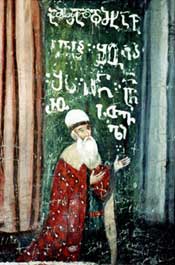
Shota Rustaveli (Rustveli) was a poet of the Georgian royal court at the turn of 12th-13th centuries. No direct biographical evidence about the poet has survived. His identity — Rustaveli (the form attested in primary sources is Rustveli; Rustaveli is established in modern speech), is confirmed in the poem’s prologue; however, his name, Shota, in Georgian sources appears first only in early 17th century. The poem must have been written during the reign of Queen Tamar and her consort, David Soslan, in about 1189-1207.
Among the many folk traditions and scientific assumptions about Rustaveli's identity, the following has been the subject of discussion: the theory of authorship by Hereti Eristavi — Shota Kupri, attested in 14th-century Georgian historical sources (chronographers) (Teimuraz Bagrationi, P. Ingorokva); the theory of Rustaveli being Chakhrukhadze, considered in various ways (N. Mari, folk traditions from Meskheti, S. Kakabadze); the belief of the poet Rustaveli being the bishop of Rustavi or considering him a bishop (Catholics: Kalistrate Ekashvili and Ephrem II, P. Ratiani); the belief based on considering the frame-fable of The Man in the Panther's Skin as the history of the Georgian royal court of the 12th century – the authorship by Demna Batonishvili (T. Eristavi); The belief of considering the poet Rustaveli as a representative of the Kakheti-Kukheti feudal house — the Ruistaveli family (Z. Aleksidze).
Some modern scientific studies link Rustaveli's origin to Meskheti and consider him a member of the great feudal family of the Toreli (M. Janashvili, N. Shoshiashvili, S. Tsaishvili, R. Pirtskhalaishvili, G. Arabuli).
Among many folk sayings and scholar assumptions on Rustaveli’s personality, the most popular today is the point of view that the author of The Man in the Panther's Skin is Shota Rustaveli, the treasurer, depicted on the wall of the Georgians’ Monastery of the Holy Cross in Jerusalem and also mentioned in a book of offerings to the dead. On one of the central pillars under the dome of the Monastery, between the frescoes of St. Maximus the Confessor and St. John of Damascus, the portrait of an elderly, noble layman with his hands raised in a prayer is depicted. The inscription in Georgian is “Rustaveli” and above the image is the phrase, which is generally deciphered thus: “God forgive Shota, the painter of this. Amen”. A book of offerings to the dead reads as follows: “On the same Monday, a funeral feast and prayers for Shota the Royal Treasurer”. Both the fresco and book entry are believed to have been made in the first half of the 13th century.
The Title of Rustaveli's Poem. The title of the poem, The Man in the Panther's Skin immerses the reader in the literary world. This title in itself is a figure of speech that refers to the main couple of the poem. The knight in the panther's skin is Tariel, who is in love with the young Nestan. The panther is a symbolic figure of Nestan. Consideration of a couple in one name has an analogue in 12th-century oriental poetry. This also connects Rustaveli to his era.
There is also a problematic issue regarding which animal is meant by Rustaveli's “tiger”. In modern Georgian the word “tiger” unambiguously refers to a wild predator of the feline species – a tiger, however, in ancient Georgian the word “tiger” had a broader meaning and, in texts translated from both Greek and Persian, corresponded primarily to a leopard, or a panther. The “tiger” in Rustaveli’s poem was perceived similarly in ancient Georgia, as is clearly evidenced by the miniatures of the 17th and 18th century manuscripts of the poem. So, the young man in a tiger’s skin in Rustaveli’s poem is a young man dressed in a panther’s skin.
The Man in the Panther's Skin as a title presents another problem for the translator. Roughly translated, this word means one dressed in a panther's skin or one who wears a panther's skin. Therefore, translators prefer to refer to the person who wears a panther’s skin: The Man in the Panther’s Skin (Marjorie Wardrop), The Knight in the Panther’s Skin (Venera Urushadze), The Lord of the Pantherskin (Robert Stevenson). Of these titles, The Knight and The Lord over-specify the identity of the foreign personage implied in the title of Rustaveli's poem, and thus, The Man is preferable in its neutrality.
Plot of The Man in the Panther's Skin. The Man in the Panther's Skin is an epic of about 1600 quatrains containing lyrical passages with a plot enacted in Arabia and India – two stories that are compositionally united. The compositional unity is achieved through inter-linked short stories each of which is compositionally complete and the beginning of the second story is embedded in the end of previous story, and so on. No deviation from this system of the development of the plot can be observed in the composition of the poem. Conforming to the Renaissance literary style, all movements in the poem’s plot are strictly motivated and subordinated to the author’s concept. Each episode enters the composition only in the size that is necessary for the development of the main story. Not a single secondary episode is renewed and continued in other sections of the plot. These secondary episodic stories with their possible interesting continuations are closed in the poem without sequels. Rustaveli narrates only what is indispensable for the movement of the principal link of the subject. The composition of The Man in the Panther's Skin is clearly related to the classical model of the epic style as defined by Homers poetry and analyzed by Aristotle in his Poetics. Rustaveli narrates a chronologically long story briefly, giving a detailed account only of individual episodes. The aggregate of a long story conveyed in brief and the principal episodes described extensively is regulated by the reminiscences and narratives of the characters inserted in the narration of the main story. Rustaveli discusses this specific style of epic narration theoretically in the prologue to his poem.
Oriental Fable. The plot of the poem unfolds through an oriental type framework adapted to Georgian reality, as pointed out by the author himself: “This Persian tale, now done into Georgian, ... I have found it and mounted it in a setting of verse”. The adventure of Rustaveli’s principal enamored couple Nestan Darajan (the daughter of the king of India) and Tariel (serving as army commander of India and a man of royal extraction): combining a search by Tariel and his companion Avtandil (army commander of Arabia) for Tariel’s love Nestan, lost through an intrigue at the Indian royal court (upon the decision by Nestan and Tariel, Tariel kills the son of the King of Khvarazmeti, invited by the court as Nestan’s would be husband); pointing to the trace of the lost beloved by King Pridon (a casual acquaintance of Tariel); learning about Nestan, imprisoned in Kajeti fortress (the city-fortress of the demonic kingdom) in order to marry her to the son of the Kajeti King; the freeing of Nestan from Kajeti by the three friends with the help of Pridon’s warriors – represents a typical oriental narrative, one archetype of which is seen in the ancient Sanskrit epic Ramayana.
Rama, the son of the Indian king and successor to the Indian throne, wanders in a dense forest as a result of intrigue at the royal court, and together with his companion Lakshmana he searches for his beloved spouse Sita, kidnapped from him. Along the way, he meets and makes friends with a king Sugriva, wounded and defeated in battle. Rama heals him, makes friends with him and helps him in the fight to regain his kingdom. Sugriva tells Rama of his having seen Sita led by a demon. They learn that Sita is held captive in the kingdom of the demons and that the captors intend to marry her off. They send a wizard slave to Sita. The woman sends back a precious stone to Rama as a token. The three friends, with the army of this king, free Sita from her captivity in the kingdom of the demons. Before the battle they hold a war council and, by Rama’s plan, they attack the citadel of the demons from different gates. The basic plot of The Man in the Panther's Skin clearly resembles the above-mentioned details: following the order of Nestan’s aunt, she will be hidden overseas, due to the slaying of her would be husband. First Tariel, then Pridon and finally Avtandil go in search for Nestan. The occasional acquaintance King Pridon tells Tariel that Nestan was led by demons. Following Tariel’s plan, the three friends, together with King Pridon’s warriors, conquer the Kajeti fortress.
The narrative of The Man in the Panther's Skin retains this oriental flavor in individual components as well. Clear relations are seen with the poems of Nizami Ganjavi, Fakhruddin As'ad Gurgani's Vis and Ramin, and Ferdowsi's Shah-Nameh. A direct parallel of Tariel losing consciousness at his first seeing Nestan, after being reared together with her in their childhood, is to be found in Gurgani's famous Persian romance Vis and Ramin, already popular in 12th-century Georgia: Ramin losing consciousness at the sight of Vis; the telling by Tariel, gone mad with love, of his story to Avtandil and the latter's decision to give his life to help his friend evince a relationship with the scene of establishing friendship between Majnun and the knight Nawfal from the popular oriental story of Layla and Majnun by the 12th-century Persian poet Nizami Ganjavi.
Georgian Local Color and Original Georgian Fable. Events occurring at the 12th-century Georgian royal court are allegorically hinted at by Rustaveli in the above story of oriental type. He introduces an original solution to the problem of succession to the throne, preaching the love of the two successors in place of their enmity; he reinterprets the Christian thesis of the love of one’s neighbor into the Renaissance ideal of human love; he puts Classical philosophy into the fabulous flow of oriental narrative; the endless roaming in search of the beloved is turned into the solving of the medieval theological thesis of the existence/non-existence of evil, and turns all into an original plot of a Georgian poem. Georgian local color is visible in all aspects of the poem. Even the flora and fauna of The Man in the Panther’s Skin are borrowed from Georgian, more precisely Caucasian reality.
The fact that the oriental plot is flavored with Georgian local color and Georgian worldview is not the only determiner of the poem’s original nature. The oriental plot of searching for the beloved, is imbued with, more precisely inserted in the original Georgian plot and both are considered as a whole by Rustaveli. (Rostevan, the King of Arabia, together with Avtandil, his favorite army commander, who was reared by the king himself, during hunting will encounter a weeping stranger, sitting by the river, clad in a panther skin. The king will find it difficult to contact him. The stranger disappears in obscure circumstances. Tinatin, recently enthroned by the king, will send Avtandil, enamored with her, in search of the disappeared man. After having searched for a long time, Avtandil finds the disappeared stranger — Tariel. He will hear about his tragic story — the intrigue of the Indian court, will make friends with him and will assume the duty of finding his lost beloved).
This original fable is based upon the historical reality of the Georgian court. The king of Arabia had his only daughter to be his successor. Having consulted with his viziers, he enthroned his daughter and started searching for the son in law to guarantee the protection of his kingdom. (The latest period of the 12th-century Georgian historical reality: upon the consent of his nobles, the Georgian king George III enthroned his only daughter Tamar; Tamar's two marriages with Giorgi Rusi and David Soslan). Both plot frameworks of the poem are based upon the Georgian historical reality, on the one hand Arabian original-Georgian, and oriental — the story of India on the other. (Similar to the King Parsadan in The Man in the Panther's Skin, George III's daughter was also born in his late years; similar to The Man in the Panther's Skin, husbands for Tamar were invited from foreign countries). Two ways of solving this one problem are represented in the stories of Arabia and India.
The idea of the author is becoming clear: innovative and democratic solution of the problem (the marriage of the woman, successor to the throne with the noble fellow, well-known, at the court, based upon their love) against the traditions established through the monarch etiquette (inviting a husband of royal extraction for the female successor of the throne). Thus, Rustaveli’s vision is clear — hostility of the throne claimants is replaced with love, as if hinting at the historical facts of the 12th-century Georgian court, vaguely or controversially having survived today (the story of Demna the son of the predecessor king).
Cosmological Pattern. By cosmological model of The Man in the Panther's Skin, the transcendental belief, typical to the Middle ages, is matched with Astrological conception through Neo-platonic modelling, perceived as a science in the Renaissance epoch. This was the modelling opening gates for analytical thinking and calculations through mathematical and geometrical principles. Everything is submitted to the will, plan of the Supreme Being. This will is reflected on the sky through the disposition of the planets and zodiacs. People are able to unravel things from the celestial letter (disposition of the stars and planets). The will of the providence, reflected on the celestial arc will be fulfilled, activated on the earth, on the domain of the humans. “Thanks to God, the Creator, Maker of all, by whom the heavenly powers decree what is to be done here; tis they that do all deeds hidden and some revealed” (Wardrop's translation, 1028).
It is on this cosmological pattern that Rustaveli builds his myriad-colored poetic structure.
Characters. A person, introduced by Rustaveli into the poem, is not always seen from one angle or presented according to the same principle. Characters from everyday life, such as Usen – chief of merchants, and Patman – his wife, lover of free life; viziers, merchants and some kings (including the King of India Parsadan), who merely fill separate episodes connected with them in the poem, differ radically from the ideal, i.e., non-existent heroes created by the poet's fantasy on the base of the mundane, existing. These are the couples from the royal courts of India and Arabia: Tariel-Nestan and Avtandil-Tinatin, as well as Pridon, the knight-king of the land of Mulghazanzar, Asmat, maid-servant of the Indian couple, Shermadin, loyal vassal of Avtandil, the king of Arabia Rostevan, and Saridan, the king of one-seventh of India. Such ideal types are created on the basis of conventionality and exaggeration. Conventionality here implies that a character is brought into the poem only with the sign and motive that the author has in mind and the adventures of such characters are limited strictly to the episodes that are indispensable for the course of the plot. Thus, for example, Asmat is the ideal of a loyal servant – no other manifestation of her character or emotion is to be seen in the poem. Nor do we find any episode from the life of King Pridon or Shermadin to deviate from the rationally motivated line of the development of the plot. Hyperbolizing the image and the action of the ideal hero is aimed at revealing the idea which is a part of the worldview of the author. This is the reason why the action of the character is sometimes conventional and exaggerated, by being far from the real, ordinary, logical and expected. This is how the new, desired world, dream reality for the poet is created, indicating to the worldview inclination of the author himself. For example, the fact that the king of India – Saridan, owning one-seventh of India, voluntarily joins his kingdom to the rest of India, reveals the author’s sympathy to the centralized monarchy system of the state. However, this idea of the poet coincides with the Georgian governmental structure of the 12th century.
The perception of a person from a positive angle only and the hyperbolization of this positive side is a worldview claim for a reassessment of traditional ideals. Placing an ideal man in the center of his own poetic world is an expression of Rustaveli striving towards new thinking brought by the new era. This is an emphasis, highlighting a person itself, his human emotions and ability to think analytically. This gives rise to a new reality, novel poetic world. The poet looks for hidden emotions in the hero’s spiritual world. He sees the person wrestling with his own ego and instead of the plot-related aspect of the story, he seeks to transfer the literary interest to the psyche of the character.
The emotion of the character, the depth of aesthetic experience is not only a characteristic component of the hero of the work or an adornment of his literary image. It is an essential pointer to the wholeness of the outlook of the literary world of The Man in the Panther's Skin. Events such as Tariel’s momentary loss of consciousness on first seeing Nestan-Darejan or the establishment of friendship between Tariel, Avtandil and Pridon at first sight is not a fairy-tale narrative or a simple telling of a story, it is rather an organic wholeness based on the nuances of human psyche. Exaggeration of the elevated, of viewing the beautiful is the foundation of that great love and friendship brought into play by Rustaveli as a new philosophy. Just as Tariel was charmed by seeing Nestan, so too did the knights of The Man in the Panther's Skin find a liking for each other. “He looked at me, I pleased him”, this is how Tariel describes his first meeting with Pridon to Avtandil. This attraction has a literary basis since it is not only liking the beauty seen by the eye but primarily the view of the elevated however aesthetic experience of the beautiful arising in the characters and developing into friendship and love that is Rustaveli’s new credo.
Desperate with the perfidy of this fleeting world, Tariel, who had shunned other human beings, and was ready to destroy those who attempted to learn his identity, found himself awakened at seeing something elevated, i.e., aesthetically beautiful: doomed like Tariel by human perfidy, one who had lost his courageous and reliable warriors and spiritually wounded like him, the threats of the embittered knight (Pridon) reached the skies: “I heard a shout. I looked round, a knight cried out haughtily, he was galloping along the seashore, he was hurt by a wound, his sword was broken and soiled, blood flowed down; he threatened his foes, was wrathful, cursed, complained” (W. 576).
Tariel was startled by the scene he witnessed. The enraged and wrathful knight attracted him: “I bade him say Stand! declare unto me who angers thee, O lion!” (W. 577).
Avtandil’s high art of hunting and knightly air charmed Pridon’s troops: “When they beheld him the soldiers ceased shooting, and breaking the circle. Eagerly hastened to him surrounding and pressing upon him. Wonder increased the nearer they came, rendered blind by his brightness. Awe tied their tongues and they could do nothing but look on in silence” (Urushadzes Translation. p. 143).
The world of The Man in the Panther's Skin, which presents ideal characters, is a dreamlike one. This is a world of human reality conceived through a dream; created with conventionality and hyperbole, which ignores the negative in real human emotions and interests and idealizes only the positive and the best with dreamlike hyperbole. This is a fantasy about a new reality from the medieval worldview; a transition to heavenly-divine harmony in this world, at the center of which is a person with his life and emotions.
Love in The Man in the Panther's Skin. Conforming to the moral concept of Christianity, Rustaveli considers love to be the highest form of human bliss and hence ethical category of the highest good. But he attempts a novel reinterpretation of this ethical system and love, which, at the centre of the poetic world of The Man in the Panther's Skin, is an earthly human emotion with divine elevation and essence. The concept of love in The Man in the Panther's Skin takes its inspiration from the humanistic principles of 12th-century Christian courtly literature. The literary model of the types of couples in love is based on the image of the beloved in the Persian epic of the period – a knight gone mad and roaming in the fields because he has been separated from his love. Rustaveli’s concept of love rises above the Sufic philosophy of the Persian epic as well as above the standardized conventionality of courtly poetry.
The Georgian poet sees the ideal of the mutual striving of the couples in love in their union in this world i.e., in marriage. Thereby, he is closely linked to Georgian national customs. Georgian tradition considers marriage the greatest ritual in this world. He thus adjusts his own concept of love to the highest ideal of Christian mysticism: wedding of an individual soul to Christ. This elevation of Rustaveli’s concept of love is also expressed in the fact that it turns into the object of his creative work not love per se as a personified idea, not so much the object of love, i.e., woman, but a character in love, subject, his/her psychological experiences and spiritual or intellectual elevation.
Rustaveli’s concept goes beyond the norms of Courtly Poetry. The relationship between the enamored couple of Rustaveli at its initial stage is similar to the love of the courtly poetry: love between the Queen and the knight, serving at the court. Reciprocation of love by the woman and the enamored knight’s deeds for gaining fame. At the next stage, the love of The Man in the Panther's Skin rises above the standardized model of courtly poetry, and along with the love of a woman, it grows into the love of a friend, and making a name for himself will also be manifested in service to a friend. Furthermore, this love reveals itself in the idea of love to a neighbor through compassion to a human being. The road from love for the beloved to the service for a friend and then to the idea of a compassion to the human being, a neighbor, is the road leading to the elevation. The road to a human perfection according to Plato’s philosophy is similar: from beautiful bodies to beautiful deeds and then to beautiful ideas.
Love in The Man in the Panther's Skin is this worldly human feeling and this worldly human love is already divine, meaning that human love is already divine love without its symbolic-allegorical reinterpretation. The love of The Man in the Panther's Skin is not limited by the boundary of this or that world; it stands above the mystery of death and life. Tariel believes that Nestan is no longer alive, but their love still lives on. In his imagination, he takes this love to the other world and is confident in the triumph of love in that world. And what is more important, Rustaveli believes that viewing Nestan in the other world will give a rise to the same worldly human love – “How can a lover forsake and abandon the loved one? I shall go to my lady in gladness; she will come likewise to meet me. I to her, she to me; she will weep, and make the tears flow too from my eyes” (Stevensons translation, p. 106).
The process of such re-conceptualization of human love is seen in European literature of the Late Middle Ages as well. Dante Alighieri's concept of love goes higher than the troubadour love lyrics almost in the same way. As suggested, with Dante, human love of a real woman is clearly the first stage and hence is part of divine love. This process of re-interpretation of love continued in European literature before the Renaissance, and with Petrarch, human love is already divine love without its allegorical conceptualization.
Rustaveli’s concept of love is built through a harmony of medieval and Renaissance ideals. In this harmony, the Renaissance enters on the basis of the medieval. Furthermore, Rustaveli clearly tries to place the thesis of human love in the concept of the Christian religion. He is given a basis for this by a statement in the Gospel (Matthew. 22, 37-40; Mark 12, 30-31; Luke 10, 27): “Love thy Lord” — this is the first and greatest commandment; the second is similar to this — “Love thy neighbor”; the whole faith and Prophets depend on these two commandments. Rustaveli’s concept of love is based on this theological premise, which is formulated theoretically in the prologue to The Man in the Panther's Skin: Among divine commandments love is the first and greatest. As it is divine, it is incomprehensible and ineffable. That is why the poet says that he will speak about its manifestation in this world, which is its imitation (unless it passes into adultery) preserving divine spirituality.
Rustaveli’s love is a very broad feeling. It embraces, from a definite angle, both love and friendship. Woven into The Man in the Panther's Skin is the author’s new and original concept of friendship. There are four basic factors that dominate its making: Georgian national roots expressed in the folk tradition of sworn brothers; the idea of the love of one’s friend based on the tradition of Christian ethics; the chivalrous ethic of the feudal and military aristocracy of Rustaveli’s time; and Aristotle’s teaching on friendship inherited by the Late Middle Ages and the Renaissance from Classical philosophy.
Social Life. The institution of the social life of the Georgian state of the 11th-12th centuries called “patronqmoba” (master-and-serf relationship) is reflected in The Man in the Panther's Skin. In the poet’s point of view, a centralized monarchy is the highest form of the state system. At the same time, the poet advances the principle of deference to woman, supports the possible enthronement of the king's daughter, gives independence to a woman to choose her love, and preaches the intellectual and legal equality of the heir of the royal family, whether male or female.
The social environment of The Man in the Panther's Skin alternates between the grandeur of the medieval royal court and the lightness and cheerfulness of the Renaissance demos. In his depiction of the nobles of the medieval royal court, its wealth, light and bright colors, festivity, banquets, hunting, infinite space and varied setting, Rustaveli is one of the best representatives among the great masters of the literary word: The great king of Arabia is raising his daughter for the throne. His command has reached all the corners of the country. There is no counting of the nobles at the celebration. The sound of trumpets and flutes fills the air. The banquet goes on the whole day. The young queen gives away countless valuable gifts.
In the poem, next to the medieval palaces full of gold and chain mail armor is a light and crowded city bearing the Renaissance spirit, surrounded with gardens and made beautiful with exotic flowers. The city rejoices, the sound of singing never ceases. Boats loaded with costly goods come from all directions. Merchants sell and buy. A poor man turns rich within a month. All are glad to see exotic and beautiful things. The appearance of the most handsome and brave knight Avtandil, disguised as a merchant, causes a stir in the town. All hurry there to see him, all women faint while gazing at him.
With his worldview problems, Rustaveli is linked to the Late Middle Ages, while the depth and specifics of his solutions to these problems are at the level of Renaissance thinking.
Religion. The poet’s religion is Christianity. He is a resident and apologist of the 12th-century Christian Georgian State. He acknowledges the existence of God and the immortality of soul and bases himself on the Bible, the first source of Christianity. Christian ritual practice is known to him, as well as the Apostle Paul’s wisdom and Christian interpretation of God-fearing. The poet frequently borrows images from the Bible. He takes into consideration the basic principles of Christian mysticism: Resurrection, the coming of the Bridegroom, mystic wedding, and is aware of the essential problems of Christian scholasticism — teaching on the four primary substances or roots; the theory of the Four Causes. The poet develops the rich and highly artistic traditions of Georgian hymnography and uses the theological terminology of Georgian church writings. Even phraseologically, he echoes Georgian hymnography and Patristic literature: Hymns of Ioane Minchkhi, a Georgian hymnographer, The Wisdom of Balavar, Georgian recension of the History of Barlaam and Ioasaph, the Teachings of Basil the Great and the Dialoghon of Pope Gregory the Great (both translated by Euthymius the Athonite).
In his attitude to Christian dogmatism, one feels his consideration of the achievements of the highly developed scholasticism, which in the eyes of the educated society of the period was believed to be the philosophy of Christian teaching both in Byzantium and Western Europe, for which the trail was blazed in Georgia by Ioane Petritsi, Georgian philosopher of the 12th century. There is no mention in the poem of those postulates of Christian dogmatic argumentation of which by reason and logical thinking 12th-13th-century scholasticism evaded.
This silence of The Man in the Panther’s Skin regarding the specificity of Christian dogmas is natural since the action of the plot of the epic was developed in oriental countries and the heroes of the poem are Muslim. At the same time, specific dogmas of Islam are not observed in the epic either. The essential feature of the deeply religious background of the poem is being non-dogmatic. The Man in the Panther’s Skin does not reveal any of the historically existent religious specifications exposing characters’ religious feelings.
This seeming vagueness and non-specificity of religious feeling became the basis for a variety of views in Rustaveli studies. This was accompanied by two points of view on this issue from previous centuries: on the one hand, the so-called non-Rustaveli stanza in the older copies of the manuscripts of The Man in the Panther’s Skin “does not mention the Trinity in its essence...” (the manuscripts of the 17th century and those directly derived from them begin with a pseudo-Rustaveli stanza, which is an assessment of the Christian moral-dogmatic position of the poem) and, on the other hand, the reference to the Christian mystical-allegorical position of the poem in the comments of Vakhtang VI printed in the first printed edition of The Man in the Panther’s Skin.
Various points of view were expressed by 20th-century researchers on Rustaveli's religious position: Islam (N. Marr and the continuation of his position in the first decades of the 20th century); Manichaeism (P. Ingorokva); Biblical Christianity – the recognition by faith only of the Bible and not the dogmatic postulates of the Holy Fathers (K. Kekelidze); the alignment of the religion of the poem with the traditional Georgian religious views of the Middle Ages (V. Nozadze); the further continuation of the mystical-allegorical understanding of the poem (Z. Gamsakhurdia).
Although the specific Christian background is less evident in The Man in the Panther’s Skin, it is clear that the author is a devout Christian. In this regard, not only the verses reflecting the author’s lyrical feelings (e.g., the prologue) are noteworthy, but also several essential circumstances: 1. The author, avoiding a specific-dogmatic presentation of Christian or Muslim religions, chooses a Muslim environment as the location of the poem and presents the characters as followers of this religion. It seems that he is more attuned to their indifference to religious specificity; 2. He categorically denies the unintentional allusion (hint), which may follow the scene of the arrival of the Khvarazma bridegroom in the square solemnly decorated with red colors, on the day of Easter, with the “descending” of Christ (“the bridegroom”) from heaven; 3. In the poet’s imagination, God is only the Trinity, the incarnate Lord. When he metaphorically alludes to God, he invokes only the epithets of the Trinity, the incarnate Savior.
Tolerance. Such correction of the poet’s religious stand was primarily conditioned by the social atmosphere and worldview of his times. This is tolerance – the significant characteristic feature of both European and Arabic thought of the 12th century. The religious experience of the characters of three different countries of the poem is the same. They are not separated by a language barrier either. Succession to the throne is not restricted by the gender principle: “The lions whelps are equal (alike lions), be they male or female” (W. 39). The basis of this tolerance is man; love of a human for a human; the world harmonized by love.
Tolerance is the driving force of Rustaveli's whole work. It is seen primarily in the plot of the poem, which unfolds over an extremely broad geographical area, covering the existing countries of the East at that time: India, Arabia, China and Persia, as well as unreal countries thought up by the poet: Mulghazanzar, Kajeti, the kingdom of the Seas, Gulansharo – the city of merchants. Generally, all the countries and peoples resemble each other. They understand each other. Solving the similar problems differently in Arabia and India is not caused by religious or national differences of the two countries. It can be explained by different inclinations (traditional or innovative) of the monarchs of the two kingdoms. A conflict between states is not enmity between peoples, it is a temporary radical manifestation of policy, ending in reconciliation and restoration of harmony. A unique example of this is the reception of the defeated and captured Khatavian king at the Indian royal court with great honor. This hyperbolized forgiveness indicates the atmosphere regulated by love and harmony the poet dreams about. The only kingdom, the destruction of which Rustaveli describes, is the unreal, inhuman, imaginary and fairy-tale-demonic kingdom of Kajeti.
Tolerance is also adaptation to a grave life situation, a quality and capacity to endure and accept what is difficult for you to do, but is dictated by your own mind. That is why Avtandil urges Tariel: “Do not heed to your heart’s promptings; do what you ought, and not what you would” (Stevenson’s translation, p. 105-106). That is why, when Avtandil lies in Patman’s bed, though he finds it hard, he considers it humiliation of his dignity and expresses his inner feeling in a rhetorical outcry: “See me now, O lovers! he cried within his heart - like a nightingale with a rose of my own, perched like a crow upon a rubbish heap!” (Vivian’s translation, p. 166). In this case, Avtandil follows in the wake of the Christian commandment of loving one's neighbor.
By tolerance, Rustaveli primarily means religious tolerance between Christianity and Islam. The poet, who is profoundly religious, feels the atmosphere of the future – the atmosphere of the Renaissance world view – and strives towards it; With its religious tolerance, The Man in the Panther’s Skin resembles one of the main principles of the Renaissance worldview of the Italian Platonists, which emerged a couple of centuries later – religious-philosophical tolerance.
The poet’s deep religious feeling, grown from his Christian faith, does not reveal specific postulates of dogmatism. The actions of the Muslim characters in the poem are indifferent to the dogmatic principles of this religion. Their actions do not show the ritual practice of religion. The basis of the poem’s worldview is a religious vision that is equally acceptable to the Arab Avtandil, the Indian Tariel, the Mulghazanzarian Pridon and the Gulansharoan Patman. It is in this way that Rustaveli moves from the Middle Ages to the Renaissance – towards worldview tolerance.
Renaissance Trends. The Bible and ecclesiastical writings are not Rustaveli’s only source of thought. His work brings to the fore such impulses of a new type of socio-philosophical thought that were called Humanist, Platonist and Aristotelian movements in the European reality of the Renaissance period. Of the main principles of humanism of this period, The Man in the Panther's Skin evinces a striving for the Classical models of wisdom and thought and highlights man's privilege and dignity. Rustaveli's emphasis on cognition, conceptualization of love and friendship as the highest forms of human cognition and religious-philosophical tolerance bring him close to the ideas of Platonism of the same period. The basic characteristic tendencies of Aristotelianism of the same period is noticeable in The Man in the Panther's Skin: placing the ideal of moral perfection at the center of human philosophy and the independent value of life in this world, or the independence of the behavior of the characters of the poem from hope or fear of life in the future world.
The Renaissance element in The Man in the Panther's Skin was noted early on (P. Ioseliani, I. Javakhishvili), but as it was geographically and chronologically distant from Europe and its literary and philosophical process. The defining element of the worldview essence of Rustaveli was considered to be the so-called Eastern Renaissance concept (Sh. Nutsubidze). Subsequently, in the so-called Soviet literary criticism, this point of view, as an emphasis on national cultures and, in general, Eastern privilege, was expanded and rethought. Rustaveli's work was considered a general elevation of secular literary thought and was placed in the chronological row of the great representatives of Persian literature: Ferdowsi, Gurgani, Nizami, Rustaveli, Nava'i. With this understanding, Rustaveli's worldview was removed from the process of development of Georgian Christian social and literary thought, the direct development of which was also its zenith.
The Renaissance worldview in The Man in the Panther's Skin is of the type that is specific to the European Renaissance. This is due to the fact that the process of Christian thought in Europe, as well as in Georgia, of the 11th-12th centuries, is essentially of the same type – the gradual movement of the Christian worldview from dogmatism and asceticism to ancient philosophy and humanistic ideals. In this process, the flow of Eastern thought also had its place, which characterizes both Rustaveli's work and the European Renaissance era.
From the 1960s, an internal protest against the attitude that Soviet ideology had established towards the country's Christian past gradually emerged in Georgian public life. This was done by seeking a close connection between Rustaveli, as the highest manifestation of ancient Georgian literary and philosophical thought, and the medieval Christian worldview. In this way, some of the researchers of Rustaveli's work reduced the philosophical and theological worldview revealed in The Man in the Panther's Skin to medieval Orthodox Christianity. Such a point of view fails to take into account the essence of the social and, in particular, Christian thought process of the late Middle Ages, and deprives Rustaveli's worldview of its originality and the specificity that is expressed in his work as one of the best manifestations of the process of Christian philosophical-theological thought from the Middle Ages towards the Renaissance atmosphere.
Ancient Philosophical Trend. The intellectual aspirations of his age lead Rustaveli directly to Classical Greek philosophy. His worldview has clearly an imprint of Classical philosophy (both of Plato and Aristotle) on the one hand, and a profound conceptualization and development of Neoplatonic Theosophy (in particular of Pseudo-Dionysius the Areopagite), on the other.
The poem directly references Plato's philosophical statement about the suffering of a person in this world and the subsequent suffering of his soul in the afterlife due to ethical flaws: “I venture to remind thee of the teaching of a certain discourse made by Plato: Falsehood and two-facedness injure the body and then the soul” (W. 770). Rustaveli consistently conveys Plato’s view of ethical flaw or injustice (Politheia , II and X): injustice, ethical flaw, stemming from falsehood, harms man first in this worldly life – in corporeal existence, and later it affects the person's soul in the heavenly abode. Rustaveli dreams of life in this world ordered by divine harmony. The worldview of The Man in the Panther's Skin brings to the fore divine harmony and justice as implemented in this life; at the same time, he retains his belief in the existence of the same justice in the other world, eternal life. That is why the author needs a categorically strong thesis – for moral defects, a person will be punished not only in the afterlife, but also in this world. He finds the declamation of this thesis in Plato. The philosophical underpinnings of seeing the love and friendship in The Man in the Panther's Skin as divine emotions can be felt in Plato's Symposium. Based on the same work, the poem alludes to ancient mythological figures.
Aristotelian influence is largely seen in The Man in the Panther's Skin in the spheres of ethics and poetics. Development and novel interpretation of Aristotle’s concept of friendship and definition of the essence of soul can be observed in the poem. Rustaveli's original concept of friendship – arising from the social and cultural as well as national specific postulates of the period – is in principle related to Aristotle’s ethical system: friendship is most essential for life; the highest form of friendship is that of ethically perfect individuals, which is facilitated to a considerable extent by some rearing and social standing; a true friend forgoes all human benefits in order to be useful to his friend. The three principles of genuine friendship that are essential to Aristotle’s ethical conception are formulated in The Man in the Panther's Skin: “Three are the ways of showing friendship by a friend: First, the wish for nearness, impatience of distance; then giving and not grudging, unweariedness in liberality: and attention and aid, roaming in the fields to help him” (W. 758).
In the wake of Christian and Arabic scholasticism of the 12th-13th centuries (Averroes, Thomas Aquinas, and others), Rustaveli rests on Aristotle’s metaphysical definition of the soul (soul is the face or form of the body, completion, and entelechy) and he (Rustaveli) introduces it into a theological thesis: every soul is created by God. On the basis of these theological and philosophical postulates, he commits his own soul to God in the second quatrain of his poem: “O one God, thou created the face of everybody! Defend me, give me strength to trample upon Satan...” (stanza, 2).
Aristotle’s ethical ideal leads Rustaveli to the apotheosis of human moral-physical perfection: “To a lover, beauty, glorious beauty, wisdom, wealth, generosity, youth and leisure are fitting; he must be eloquent, intelligent, patient, an overcomer of mighty adversaries” (W. 8).
The Golden Mean. This ideal of human perfection rests on the thesis of Aristotle's ethical philosophy called the golden mean. According to The Man in the Panther's Skin, each act as well as each property is best when it is the mean between two extremes, e.g., abundance is the mean of profligacy and close-fistedness, and so on.
The only advice given by Rostevan to his newly enthroned daughter was to be abundant (abundance according to Aristotle’s ethical conception is the most popular virtue with the people). At the banquet, Tinatin gave all her inherited wealth away. Towards the end of the feast, Rostevan was seen to fall into low spirits. Avtandil and Sograt the vizier said to him in jest: “Thou art right, for, lo! your daughter with lavish hand has given away all your rich and costly treasure” (W.60). Rostevan was able to feel the humor that his sadness was perceived as his stinginess: “He who lays avarice to my charge is a lying chatterer” (W. 61).
All principal actions and features, like courage (being intrepid); selecting the ways of penetrating the Kajeti fortress; trying to find a solution out of the situation caused by inviting a future husband for Nestan — typical to the ideal characters of The Man the Panther's Skin — is determined by the above mentioned principle.
Areopagitic Trend. Dionysius the Areopagite is named by the poet. In discussing the Supreme Being, use is made of the Areopagitic theological method of defining God by joining oppositional positive and negative names (the so-called cataphatics - apophatics). The Areopagitic proposition is presented on the interpretation of the medieval question of the essence of good and evil, namely on the substantial non-existence of evil. It is important that this latter thesis is the philosophical motivation for the development of the subject of The Man in the Panther's Skin. And which is essential, according to the interest of the new epoch in analytical and practical inquiry, the thesis of the non-existence of evil in the poem is the subject not only of theological-metaphysical discourse but of practical-experimental search as well. At the very beginning of the story of The Man in the Panther's Skin the strange knight, encountered while hunting, and his miraculous disappearance were taken by King Rostevan to be the advent of an evil force. Using a theological argument, the king’s daughter, Tinatin, tries to persuade her father of the opposite: “why should the Creator of good make evil!” (W. 112). But to convince herself, she launches a practical search by sending Avtandil on a long journey in quest of the strange knight, saying: “If thou find him not, I shall believe he was a vision” (W. 131).
Harmony of the Medieval and the Renaissance. Thus, a peculiar synthesis is seen in Rustaveli's outlook of Neoplatonism, stemming from Dionysius the Areopagite as well as the logical and metaphysical thought known as Aristotelian in the Late Middle Ages, and its conceptualization on the basis of highly-developed Christian theology. It is clear from this specific synthesis that Renaissance horizons take shape in the poet’s worldview and Dante Alighieri still appears next to it in the European Literature.
Confidence in the value of earthly reality, genuine perception of the beauty of the human world, and trust in human reason and intelligence in Rustaveli’s work directly – without opposition – merge with the traditional Christian ideal of the immortality of the soul, the eternity of the good and merciful creator, and the faith in the merger with this infinite God following death. This too is a feature of the first explosion of Renaissance ideals. Thus, with Rustaveli the traditional medieval ideals, the basic postulates of Medieval faith merge harmoniously with the Renaissance ideal of this worldly reality. In other words, the worldview of The Man in the Panther's Skin is a harmony of the Medieval and the Renaissance. Such confidence in the dual ideal of human and divine must have been filled with a deep experience of internal glory and calmness. This worldview specificity must be responsible for the great poeticism preserved to this day by The Man in the Panther's Skin.
The Man in the Panther's Skin is one of the great literary works of its contemporary and immediately following or preceding creations to highlight the new world outlook – most consistently-romantically colored realistic outlook – established in Medieval transcendental worldview. Rustaveli is the youth of the present-day thought. Placing trust in beauty, strength and supreme spiritual and emotional ideals, the poet dreams of human happiness, seeing this happiness, along with eternal life, in the triumph of good in this life and in human love.
Both the poetic world of folk fantasy and, in general, the medieval system of ideas and images is only a backdrop or poetic setting for Rustaveli’s new artistic thinking. The traditional characters of folk fantasy — devi (ogre), kaji (demon), as well as the medieval objects or actions – cladding oneself in an animal’s skin, dwelling in a cave, slaying of a lion, flying steed, sorcerer slave, form a natural background of medieval poetic fantasy against which the characters of the period of Renaissance act with their human intelligence and emotions. In the poem, the components of the medieval context are more or less deprived of their traditional symbolic, magic or allegoric content or suggestions, retaining the poetic accessories of medieval aroma.
Movement from the Medieval to the Renaissance, from the mystic to the intelligent and real is revealed in the actions of Rustaveli's characters. An evil power who came as a foe is defeated by the Holy Father with a word-divine miracle. The same enemy is overcome by a medieval knight with the aid of fairy-incredible force. Rustaveli’s character possesses the same force – God is with him, and at the same time his victory is motivated by human mind, stratagem, and calculation: Tariel's plan of entering the Kajeti fortress is based upon an exact calculation of the control and laws of a medieval fortified city. Avtandil's fight against the pirates is based on successful tactics and technique of battle. The three matchless knights, guided by divine light were given an advantage in arms to fight in the Kajeti fortress. They were clad in diamond coat of mail and helmet to smash the arms of the enemy; they held a sharp steel sword. To find Nestan’s location Avtandil does not follow the path shown by a divine miracle, nor does he look in a magic mirror. He goes in the direction where, in Pridon's words, the slaves carried the chest with Nestan and from where she failed to return; he stops in the city where all boats harbored. This is a new in medieval setting – human calculation, work of logic; bringing in analytical thinking in Transcendental world sentiments.
Aesthetic Phenomenon and Poetic Hand. Along with Georgian national folk and literary traditions Rustaveli's work is nourished by the rich traditions of Oriental, Persian-Arabic epic and lyrics. The aesthetic phenomenon of The Man in the Panther's Skin is created largely by hyperbolic and symbolic poetic images (astral symbolism, symbolism of the animal world, symbolism of precious stones and the vegetable world). Especially important in poetic semantics is metaphoric speech, as well as repetition, parallelism and epithet. Rustaveli introduces his own style in traditional poetics. This is especially felt in the fields of poetic vocabulary (derivation of verbal and adjectival forms from nouns: “mze aghar mzeobsdari ar darobs” (The sun no longer shines on us; the weather is not bright W. 801); “ena enda” (the tongue tongued ); and “disagantsa upro desi” (more sisterly than a sister - W.248). His style is also felt in poetic syntax, in the abundance of verbal forms to indicate the expressiveness of action and in the reduced use of conjunctive words: “mterta ekadda, tsqreboda, igineboda, chioda” (he threatened his foes, was wrathful, cursed, complained W. 576); “mightsvian, momigoneben, damlotsven movegonebi” (they will be grateful to me, remember me, bless me; I shall be thought of W. 784.)
The Man in the Panther's Skin is considered a norm in the field of versification of Georgian poetics. In contrast to medieval epic style, monotonousness is averted through the alternation of two variants of shairi, the Rustaveli poetic meter. The beginnings of this verse form are attested not only in Georgian folk poetry but also in literary tradition proper from the 9th century, reaching the zenith of its perfection with Rustaveli. The higher shairi – a 16-syllable line of which each half-line is divided by caesura into 4-syllable sections (4/4//4/4) – is characterized by a more expressive rhythm, while the lower shairi (3/5//3/5; 5/3//5/3), with its comparatively unhurried rhythm system, is more appropriate for epic narration and philosophical maxims. It has been noted that at substitution of Rustaveli's asymmetric strophes of the lower shairi for symmetric strophes of the higher shairi , the former moves into maximum harmony or correlation of the so-called golden section; that is to say, the number of syllables – 8, of the semi-strophe is in such a relation to the number of syllables – 5, in the large rhythmic section as the latter is in relation to the number of syllables in the smaller section – 3. Each strophe of Rustaveli's shairi consists of four lines rhyming with one another (the outside rhyme). The rhyme is predominantly two or three-syllable, though four-and five-syllable rhymes also occur.
The attractiveness of the poetic world of The Man in the Panther's Skin is to a certain extant due to the harmony of high content value and perfection of expression, manifested in aphoristic speech as well. Aphoristic speech is the most spread trend of medieval philosophical thinking, Ecclesiastes by Solomon being the most prominent example of it. Rustaveli's wisdom, having molded the Georgian people through centuries is expressed through this Aphoristic speech. Christian virtue, Classical Greek philosophy, Georgian folk and Oriental wisdom in Rustaveli's poetic art is molded into pithy, elegantly expressed, broad apophthegms, wise pronouncements, creating, with their versatility a philosophical code of human optimism, wisdom and high morality.
Manuscripts of Versions and Continuations of The Man in the Panther's Skin. There are 164 preserved manuscripts, rewritten in 17th century and after. The oldest record belongs to the edge of 16th-17th centuries. The oldest manuscript dates back to 1646 (rewriter and the author of the miniatures – Mamuka Tavaqarashvili). All the old (17th century) manuscripts belong to one editorial, one version of the reproduction, with already included stanzas and continuations. The version preserved in these manuscripts is called an extended edition. The first printed edition of the poem, dating back to 1712, includes a so called short version, which should have been created through the critical reproduction of the extended edition. There are two more editions of the poem preserved in late manuscripts, dating back to the 18th and 19th centuries. They included the mixed versions of short and extended editions of the poem. All old manuscripts contain the text of the so-called extended edition. The first printed edition of 1712 is the so-called short edition, which must have been obtained from a critical revision of the extended edition. In comparison to the extended edition, the short one lacks three long stories at the end, which are called continuations. They do not seem to belong to Rustaveli, at any event, in the shape they have come down to us. This is indicated by the sharp difference between the literary structures of The Man in the Panther's Skin and so called continuations: difference in the worldview system, breakdown in the composition style of The Man in the Panther's Skin, collapse of the literary structure of the conventional depiction of characters.
The Man in the Panther's Skin has been published many times. In order to determine the authentic text, D. Karichashvili, S. Kakabadze, P. Ingorokva, M. Tsereteli carried out their own editions based on critical study of the manuscripts of the poem. The editions of the text-establishing commissions are also noteworthy (1712, 1841, 1888, 1937, 1966, 1988).
The popularity of The Man in the Panther's Skin was boosted by the anniversaries of 1937 and, especially, 1966 — the latter was celebrated worldwide by UNESCO. In 2016, the Shota Rustaveli Institute of Georgian Literature at Tbilisi State University held an international scientific conference dedicated to the 850th anniversary of the creation of The Man in the Panther's Skin, in which scientists from different countries of the world (USA, Great Britain, France, Japan, Russia, Bulgaria and Azerbaijan) participated. The poem and related issues are still studied by scholarly discipline.
Conceptualization of the Poem in Georgian Society. The Man in the Panther's Skin appears to have gained popularity in Georgian society rather early. From the end of the 14th-century we come across jottings of separate lines of the poem on the margins of church writings, pointing also to verbal quoting of excerpts of the poem by the Georgian clergy. In a definite period of Georgian social life some movement must have taken place against the poem, which was probably an echo of the Christian radicalism in 16th-century Europe. At any rate, the extant old manuscripts of the poem date only from the 17th century, stemming from a single recension. It is believed to basically differ from Rustaveli’s original by only the closing part, the so-called supplements. It must contain the continuations that were probably created like in the Persian literary tradition after the poem became popular. This recension involves an added introductory stanza that presents the poem as a secular work differing from the church ideology and writings, and advises the reader to give a wide berth to its worldview; by doing this, it enables one to read or propagate it as a secular work.
The commentary added by the Governor of Kartli, Vakhtang VI, to the first printed edition of The Man in the Panther's Skin seeks to reconcile the worldview of the poem with the church, laying the foundation for the allegorical-mystic interpretation of the poem. In the 19th century, allegorical interpretation of the plot of The Man in the Panther's Skin as the historical reality of Georgia was popular. The 20th-century Soviet ideology began to look for anti-religious passages and materialistic hints in the poem. From the last quarter of the same century, Georgian literary criticism inclined as a reaction to the understanding just cited to an allegorical - religious interpretation of The Man in the Panther's Skin.
The Man in the Panther's Skin in the European Environment. We may presume that the notes on Rustaveli's poetic works must have crossed the borders of Georgia in 13th-14th centuries, mostly to the East. The main reason why we think so is the preserved unknown poem by Rustaveli, translated from Arabian into French.
Acquaintance with The Man in the Panther's Skin beyond the borders of Georgia began in the 19th century, due, in a way, to the endeavor of the Georgian society to project into European space the greatest phenomenon of its own culture and national identity.
The first translations of The Man in the Panther's Skin published in Europe are: Polish (Kazimir Lapczynski1863, Warsaw), German (Arthur Leist 1889, Dresden, Leipzig), English (Marjory Wardrop -1912, London). To date, the poem has been translated into about fifty languages of the world, some of them several times.
The plot of The Man in the Panther's Skin is the literary source for two famous plays by the English playwrights, Francis Beaumont and John Fletcher, of the first decade of the 17th century: A King and No King and Philaster, as well as Shakespeare's Cymbeline. These plays introduced into English dramaturgy a theme from The Man in the Panther's Skin, previously unknown to their authors: the conflict between the king and the only female heiress of the kingdom over the groom chosen for her.
The main plot point of both Beaumont and Fletcher's plays is from The Man in the Panther's Skin. In the play A King and No King, the action takes place in Georgia. A childless king and queen adopt the newborn son of a close nobleman. Five years later, the queen becomes pregnant and gives birth to a daughter. The children are initially raised together. After the separation, they never see each other while growing up. The newly crowned son, who does not know that he is adopted, loses his mind with sudden love at the first sight of his “sister”. The woman responds with the same feeling. The action of getting rid of the young king of a neighboring country, who has been brought as a groom, begins. A happy wedding is described at the end. In Philaster, one kingdom will unite with another. The king of a united country intends to enthrone his only heiress, a woman, and invites the prince of a neighboring kingdom as a groom. The daughter is against it. She secretly loves the prince, the heir to the throne of the united kingdom. She sends a letter to him through a maid and invites him. The man and woman swear allegiance to each other and decide to reign together. The action to get rid of the invited groom begins. The finale is happy and ends with a wedding.
The relation of Shakespeare's Cymbeline to The Man in the Panther's Skin is more evident in the play's theme, idea, and plot construction, which radically distinguishes it from the author's earlier works. The plot is as follows: the king has only one daughter left as heir. The king and queen have chosen a representative of the royal family as her fiancé. The daughter rejects the offer and marries a worthy young man raised with her. Idea: A woman's marriage should be by her own choice, out of love, and not according to tradition — by the decision of the king and queen. The heiress can marry a subject of the royal court of her own choice, and not necessarily a person from the royal family. Composition: The beginning of the action and the identification of the problem at the royal court; the development of the action and its transfer to another space, outside the country; a happy ending at the royal court. Individual components of the composition of Cymbeline also hint at The Man in the Panther's Skin: the action takes place in a cave; there, old stories from the royal court are recalled; the heir to the throne kills the groom, who is trying to usurp the throne.
All three plays of English dramaturgy are connected to The Man in the Panther's Skin by plot episodes and artistic figures, for example: thinking of the beloved as dead and the meditation on the journey towards her (heaven); the female protagonist of the work (the heiress, based on the prototype of Nestan) being referred to as the panther (A King and No King); the sight of the knight sitting by the water's edge while hunting; the madly in love protagonist rushing into the forest (Philaster); the involvement of three knights (including the heir to the throne who has fled the country) in a war against an enemy who has invaded the country and their victorious return to the royal court; the letter written by the heiress to the exiled lover; a reference to the creation of “just justice” (Cymbeline).
The most plausible assumption about the introduction of The Man in the Panther's Skin into the English theatrical circle or the detailed penetration of the plot of the poem should be connected with the longterm visit of a large group of English travelers to the Persian royal court in the very end of the 16th century. During this period, the English royal court and intellectual circles were interested in bringing unknown historical, literary or fairy-tale stories from abroad. The great earls close to the English royal court, who were also sponsors of the king's theatrical troupe, sent the famous traveler, Sir Anthony Shirley, to the court of Shah Abbas with a large group of companions. It is believed that Shakespeare was familiar with the details of this journey. The information that the members of the group and Shirley personally provided to the earl, who financed the expedition, can be seen in his plays. Sources published in 17th-century England indicate that this delegation was protected in Persia by the Shah’s chief advisor and commander-in-chief, Allahverdi Khan Undiladze, who was Georgian by origin. The same delegation was assisted by Shah Abbas’s young Georgian wives, the daughters of the kings of Kartli and Kakheti.
It seems that The Man in the Panther’s Skin was known in Europe, in particular among English playwrights, at the beginning of the 17th century and was used as a literary source.
Literature: ბარამიძე ა., შოთა რუსთველი, თბ., 1975; ბოურა მ., „ვეფხისტყაოსანი“, თბ., 1966; გამსახურდია ზ., ვეფხისტყაოსნის სახისმეტყველება, თბ., 1991; გოგიბერიძე მ., რუსთაველი, პეტრიწი, პრელუდიები, თბ., 1961; გონჯილაშვილი ნ., „ვეფხისტყაოსნის“ მხატვრული სამყაროს გააზრებისათვის, თბ., 2017; ზარიძე ხ., ვეფხისტყაოსნის კომპოზიცია, თბ., 2002; იმედაშვილი გ., ვეფხისტყაოსანი და ქართული კულტურა, თბ., 1968; იმედაშვილი გ., რუსთველოლოგიური ლიტერატურა (1712-1956 წწ.), თბ., 1957; „რუსთველოლოგიური ლიტერატურა“ − კრებულები II-VI, თბ., 2002-2018; ინგოროყვა პ., რუსთველიანას ეპილოგი: რუსთველოლოგიური თხზულებანი, ტ. 2, თბ., 1963; კეკელიძე კ., “ვეფხისტყაოსანი“: ძველი ქართული ლიტერატურის ისტორია, ტ. II. თბ., 1958; მარი ნ., ვეფხისტყაოსნის ტექსტის საკითხები, თბ., 1965; მეგრელიძე ი., რუსთველოლოგები, თბ., 1970; ნადირაძე გ., რუსთაველის ესთეტიკა, თბ., 1958; ნათაძე ნ., დროთა მიჯნაზე, თბ., 1974; ნათაძე ნ., ცაიშვილი ს., შოთა რუსთაველი და მისი პოემა, თბ., 1966; ნოზაძე ვ., ვეფხისტყაოსნის ვარსკვლავთმეტყველება, სანტიაგო დე ჩილე, 1957; ნოზაძე ვ., ვეფხისტყაოსნის ღმრთისმეტყველება, პარიზი, 1963; ნოზაძე ვ., ვეფხისტყაოსნის მიჯნურთმეტყველება, პარიზი, 1975; ნორაკიძე ვ., ადამიანობის იდეა „ვეფხისტყაოსანში“, თბ., 1966; რუსთველი მსოფლიო ლიტერატურაში, I – IV (რედ. ლ. მენაბდე), თბ., 1976-1988; სირაძე რ., სახისმეტყველება, თბ. 1982; სულავა ნ., „ვეფხისტყაოსანი“ – მეტაფორა, სიმბოლო, ალუზია, ენიგმა, თბ., 2009; ცაიშვილი ს., ვეფხიტყაოსნის ტექსტის ისტორია, I-II. თბ., 1970; შანიძე ა., (შემდგენელი), ვეფხისტყაოსნის სიმფონია, თბ., 1956; წერეთელი გ., მეტრი და რითმა „ვეფხისტყაოსანში“, „მეცნიერება“, თბ. 1973. ხინთიბიძე ე., ვეფხიტყაოსნის იდეურ-მსოფლმხედველობითი სამყარო, თბ., 2009; ხინთიბიძე ე., ვეფხიტყაოსანი შექსპირისა და მისი თანამედროვეების ინგლისურ დრამატურგიაში, თბ., 2016; ხინთიბიძე ზ., ჰომეროსი და რუსთველი (კომპოზიციური ორგანიზაციის ჰომეროსისეული პრინციპები და ეპიკური ტრადიცია), თბ., 2005; Бальмонт К., Великие Итальянцы и Руставели - Шота Руставели, Носящий Барсову Шкуру (Перевод К.Д. Бальмонта), Париж, 1933, с. ХХШ-ХХУ; Марр Н., Вступительныя и заключительныя строфы «Витязяв барсовой коже» Шоты из Рустава (Грузинский текст, русский перевод и пояснения с этюдом «Культ женщины и рыцарство в поэме»): „Тексты и разыскания по армяно- грузинской филологии”, С.П., т.ХИ, 1910; Bowra C.M., Inspiration and Poetry, London, 1955; Lang, D., Introduction: The Knight in the Panther’s Skin (translated by Venera Urushadze), Tb.,1968; Khintibidze E., Rustaveli’s the Man in the Panther Skin and European Literature, London, 2011; Stevenson R., Introduction: The Lord of the Panther-Skin (translated by R.H. Stevenson), New York, 1977; Vivian K., Introduction: The Knight in Panther Skin (translated by Katharine Vivian), London. 1977; Wardrop O., Preface: The Man in the Panther’s Skin a Romantic Epic by Shot’ha Roustaveli (translated by Marjory Scott Wardrop), London, 1912.
E. Khintibidze