Kvesitadze Giorgi
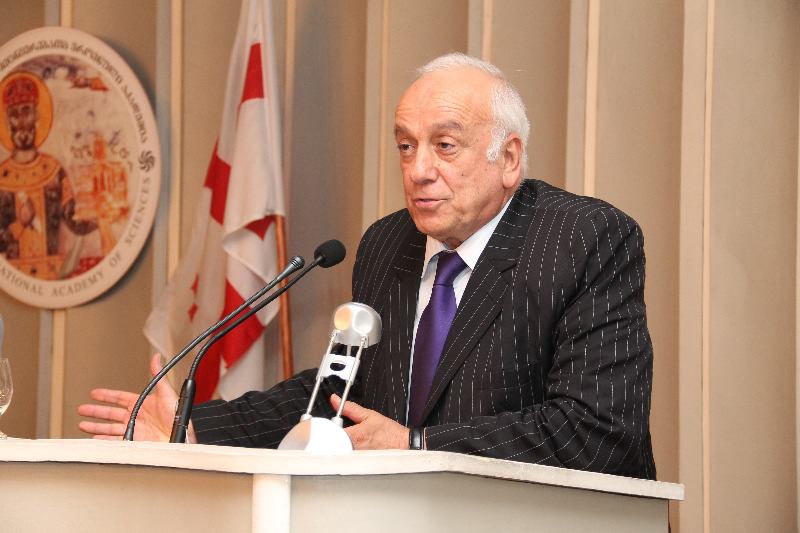
Kvesitadze Giorgi (b. May 30, 1942, Tbilisi), a biotechnologist and biochemist. He served as the President of the Georgian National Academy of Sciences from 2013 to 2023. He was elected an Academician of the Georgian Academy of Sciences in 1988 (having been a Corresponding Member since 1983); a Doctor of Biological Sciences (1980).
He graduated from the Georgian Agricultural Institute in 1964. Between 1966 and 1969, he completed practical courses in biochemistry, molecular biology, enzymology, and plant physiology at the M. Lomonosov Moscow State University. He began his scientific research career at the A. N. Bach Institute of Biochemistry (1966–1969). Within the Georgian Academy of Sciences, he served as a laboratory head (1971–1983) and subsequently as the director (1987–2008 and from 2013 to present) of the Institute of Plant Biochemistry ( since 1968 known under the name of S. Durmishidze Institute of Biochemistry and Biotechnology). He is the founder and former chair of the Department of Biotechnology at the Georgian Technical University (GTU), where he has also served as the director of the Center of Biochemistry and Biotechnology since 2012. In public service, he held the position of Minister of Agriculture and Food of the Republic of Georgia (1992–1994) and served as an advisor to the Head of State of Georgia in the fields of science and ecology (1994–1998). Furthermore, he was the Academician-Secretary of the Department of Biological Sciences of the Georgian National Academy of Sciences (2003–2013). He worked as a visiting professor at Tbilisi State University (TSU), GTU, and the Agricultural University of Georgia (1972–2010), and has been a full professor at the Agricultural University of Georgia since 2011.
Kvesitadze's primary research areas encompass the functional and structural-kinetic investigation of stable enzymes derived from extremophilic microorganisms; the development of ecological biotechnologies based on plants and microorganisms; the study of Caucasian biodiversity; His work also focuses on developing efficient methods for the immobilization of microbial hydrolytic enzymes and identifying their fields of application; Kvesitadze founded "Biotekhi," the first and only industrial biotechnology plant in Georgia, and introduced the application of alpha-amylase at the Tbilisi Yeast Plant (1972). His technological innovations were also implemented at the Olaine Biopreparations Plant (Riga, Latvia, 1970). He investigated the absorption and transformation of organic toxic environmental pollutants by microorganisms and plants. Based on these findings was developed new bio- and phytoremediation technologies.
He serves as a member of the editorial boards of various Georgian and international scientific periodicals, including Fresenius Environmental Bulletin, Ecotoxicology and Environmental Safety, and the Journal of Biological Physics and Chemistry, as well as the Russian Academy of Sciences journals Biokhimiya i Prikladnaya Biokhimiya [Biochemistry and Applied Biochemistry] and Mikrobiologiya [Microbiology], and the Don State Technical University journal Almanach of Black Sea Region Countries. He is also the editor-in-chief of the Bulletin of the Georgian National Academy of Sciences (Moambe [Moambe]).
Kvesitadze is the author of numerous scientific publications, including 9 monographs, and holds 3 international, 46 USSR, and 15 Georgian patents.
He is a foreign member of several academies, including the International Academy of Sciences, Education, Industry and Arts (California, USA, 1995), the European Academy of Sciences and Arts (2013), the World Academy of Art and Science (2013), and the Academy of Romanian Scientists (2016). He is a member of the European Federation of Biotechnology, the Federation of European Microbiological Societies (2004), and the Association for Environmental Health and Sciences (AEHS, 2005–2006). He has been awarded honorary doctorates and visiting professorships at multiple international institutions, including the University of Pennsylvania (Philadelphia, USA, 1975–1976), Lehigh University (USA, 1983–1984), the Max Planck Institute of Biochemistry (Germany, 1986), and the Technical University of Munich (Germany, 1987–1988). He was awarded the Friendship Award of the People's Government of Shandong Province, China (2017). He is an honorary citizen of the State of Georgia (USA, 2006) and of Tbilisi (2016).
Works: პრაქტიკული ენზიმოლოგია, თბ., 1975 (თანაავტ.); ბიოტექნოლოგია, თბ., 1999 (თანაავტ. ე. კვესიტაძე); ეკოლოგიის ქიმიური საფუძვლები, თბ., 2000 (თანაავტ.); Амилазы плесневых грибов и бактерий, Тб., 1984; Ферменты микроорганизмов, живущих в экстремальных условиях, Баховские чтения XLII, АН СССР, М., 1990; Введение в биотехнологию, М., 2002 (თანაავტ. А. М. Безбородов); Детоксикация антропогенных токсикантов в высших растениях, М., 2005 (თანაავტ.: Г. Хатисашвили, Т. Садунишвили); Метаболизм антропогенных токсикантов в высших растениях, М., 2007; Микробиологический синтез, СПб., 2011 (თანაავტ. А. М. Безбородов); Biochemical Mechanisms of Detoxification in Higher Plants-Basis of Phytoremediation, Berlin, Heidelberg, 2006 (თანაავტ.: G. Khatisashvili, T. Sadunishvili, J. J. Ramsden); Degradation of anthropogenic contaminants by higher plants, In: Complexity and Security. J. J. Ramsden and P. J. Kervalishvili (Editors), Amsterdam, Berlin, Oxford, Tokyo, Wash., D. C., 2008 (თანაავტ. E. Kvesitadze); Metabolism of contaminants in plants and microorganisms, In: Dharmendra Kumar Gupta, Clemens Walther (Editors): Radionuclide Contamination and Remediation Through Plants, Dordrecht, 2014 (თანაავტ.: G. Khatisashvili, T. Sadunishvili); The Science, Religion and Culture of Georgia. A Concise and Illustrated History. Caucasus Region Political, Economic and Security Issues, N. Y., 2017 (თანაავტ. R. Shengelia).
M. Gordeziani