Tmogvi
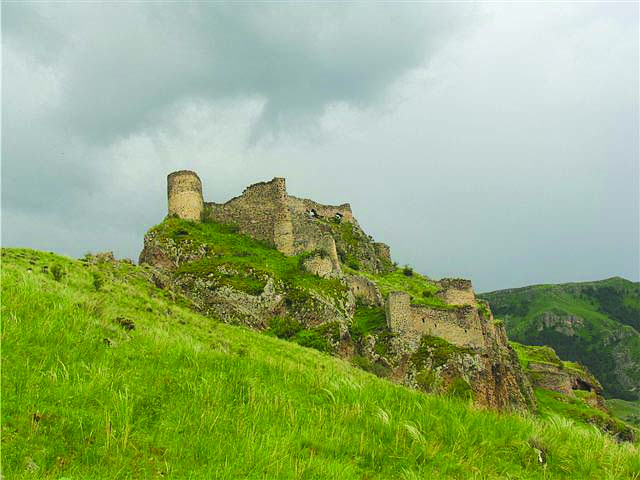
Tmogvi is a fortress-city in historical Javakheti, located in the present-day Aspindza Municipality. It was situated on both banks of the Mtkvari (Kura) River, while the fortress itself is built on an inaccessible rocky mountain on the left bank. Inside the defensive wall, there are a church, residential and agricultural structures, a tunnel descending to the Mtkvari, and two deep pits for water. Outside the fortress wall to the west, the Church of St. Ephrem is carved into the rock, with its iconostasis also hewn directly from the stone. Near the fortress gates stands a second church with a collapsed dome and remnants of frescoes in the sanctuary; it dates to the early 14th century.
The ruins of the city span both sides of the Mtkvari, with remnants of palaces present in both locations. The palace on the left bank belongs to the oldest construction layer, while the right bank features a settlement dating to the 14th century. A three-room bathhouse built of stone and Georgian brick is also located here. Bridge remnants (nakhidari) are visible in two places over the Mtkvari. One of them spanned between the two palaces, while the other, a transport bridge, was situated further downstream and connected the two parts of the city.
The transformation of Tmogvi into a fortress likely occurred after the 9th century, when Tsunda collapsed as the center of the Javakheti duchy (saeristavo). The fortress controlled the historical caravan route that entered Georgia from Byzantium through the Mtkvari gorge and subsequently connected to the countries of the Muslim East. Within these narrows, it securely blocked the road leading to Upper Tmogvi (Zeda Tmogvi), which then crossed into Buzmareti and the Niali valley. The Tmogvi fortress is first mentioned in written sources during the Arab invasion of 914.
Like all feudal-era fortresses, Tmogvi possessed its own subordinate fortress-territory. This primarily consisted of the nearby villages, mainly distributed along both banks of the Mtkvari canyon. According to Georgian sources, this unified entity was termed a "tsikhe-kvekana" (fortress-country). Georgian kings would frequently grant the Tmogvi tsikhe-kvekana to their loyal officials as personal possessions. Parsman Tmogveli appears in 11th-century sources; he is the first individual bearing the epithet "Tmogveli" mentioned in historical records.
During the reign of Queen Tamar, Tmogvi was transferred to Sargis, son of Varam Mkhargrdzeli. Following this, this specific branch of the Mkhargrdzelis secured the possession of Tmogvi for an extended period, which is reflected in their adopted surname, "Tmogveli." In the early 13th century, they also took possession of the Vani Caves (Vanis Kvabebi) monastery.
By the end of the 13th century, the power of the Tmogvelis gradually declined. By the first half of the 14th century, they were no longer present in Javakheti. Subsequently, the Gharibasdze family took possession of Tmogvi and the Vani Caves. A 1350 inscription from Tmogvi informs us that Murvan, the scribe of the royal bedchamber, built the defensive wall of Tmogvi. The royal official Murvan was a representative of the Gharibasdze family, and he is documented as the owner of Tmogvi and its adjacent territory. It is presumed that in the early 14th century, he built the domed church at the gates of Tmogvi to serve as his family crypt. His descendants are mentioned in later marginalia of the typikon of the Vani Caves monastery.
From the 15th century, the Atabegs of Samtskhe conquered Javakheti. From a 16th-century register of the flock and properties of the Mtskheta church, it is evident that the lands of the old feudal landlords had acquired new owners. In the former domain of the Tmogvelis, two feudal families had emerged: the Shalikashvilis and the Rcheulashvilis.
At the end of the 16th century, in Southern Georgia (which had been conquered by the Ottomans), Tmogvi served as the center of a nahiye included within the liwa of Akhalkalaki. According to the "Great Defter of the Vilayet of Gurjistan," the Tmogvi nahiye encompassed the villages of the Mtkvari canyon from Nakalakevi southwards, including the village of Vashlobi—comprising a total of 22 active and abandoned villages. Under the Ottoman administrative division, this nahiye was essentially the ancient tsikhe-kvekana of Tmogvi, representing an economic and administrative-territorial unit that had been formed over centuries.
Literature: ბერძენიშვილი დ., ვარძია და თმოგვის ციხე-ქვეყანა, «ძეგლის მეგობარი», 1988, N2; სხირტლაძე ზ., ღმრთისმშობლის მიძინების კომპოზიცია კუმურდოს ეკლესიაში, «მაცნე». ისტ., არქეოლ., ეთნოგრ. და ხელოვნ. ისტორიის სერია, 1992, ტ. 2.
D. Berdzenishvili