Kondamiani
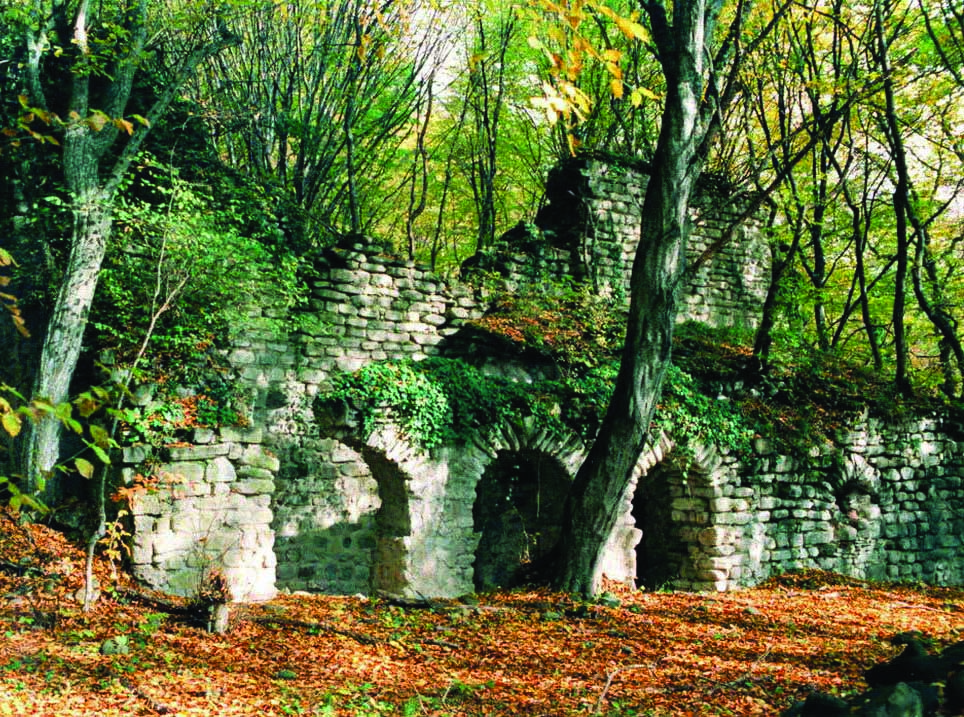
Kondamiani, a monument of Georgian architecture of the 6th–7thcenturies. It was built in the name of Saints Cosmas and Damian. It is located about six kilometers south of the village of Kisiskhevi, on the left bank of the Kisiskhevi River. A low cobblestone wall surrounded the churchyard (survived in fragments). Kondamiani is an early type of three-church basilica. The outer rectangle of the building plan contains three stalls located side by side, separated by blank walls, which are independent churches connected to each other by an arched door cut into the dividing walls. The building is built with straight rows of selected cobblestone. The door and window openings, imposts and some arches are outlined with cleanly hewn yellowish-colored limestone. The middle church is higher and more spacious than the side churches. On the east side, it ends with a crescent-shaped apse. The main church was lit by six windows. One window each on the east and west sides, two on each of the long walls. Later, during the renovation of the vault, a single retaining wall was built on the western wall of the church to support it. Iconostasis was also built later (remains have survived). The northern church is covered by a cobblestone vault. At the eastern end of the northern nave, a rectangular room is allocated for the prothesis, the entrance to which is from the western part of the nave. The latter is opened from the outside by a double horseshoe arch, arranged in squares of limestone, supported on imposts. The southern church occupies the eastern half of the corresponding nave. It is an apsidal, windowless small stall, under which is a crypt. The rest of the nave is opened to the south by a three-bay arch supported on two square pillars. The walls of the church were finished on the outside with a cornice decorated with a row of u-shaped arches. The church was roofed with tiles. To the southwest, a few steps from the church, there are signs of a building, and to the south, close to the church, there is a large pool plastered on the inside.
Literature: საქართველოს ისტორიისა და კულტურის ძეგლთა აღწერილობა, წგ. 1–2, თბ., 2015; Чубинашвили Г. Н., Архитектура Кахетии, Тб., 1959.